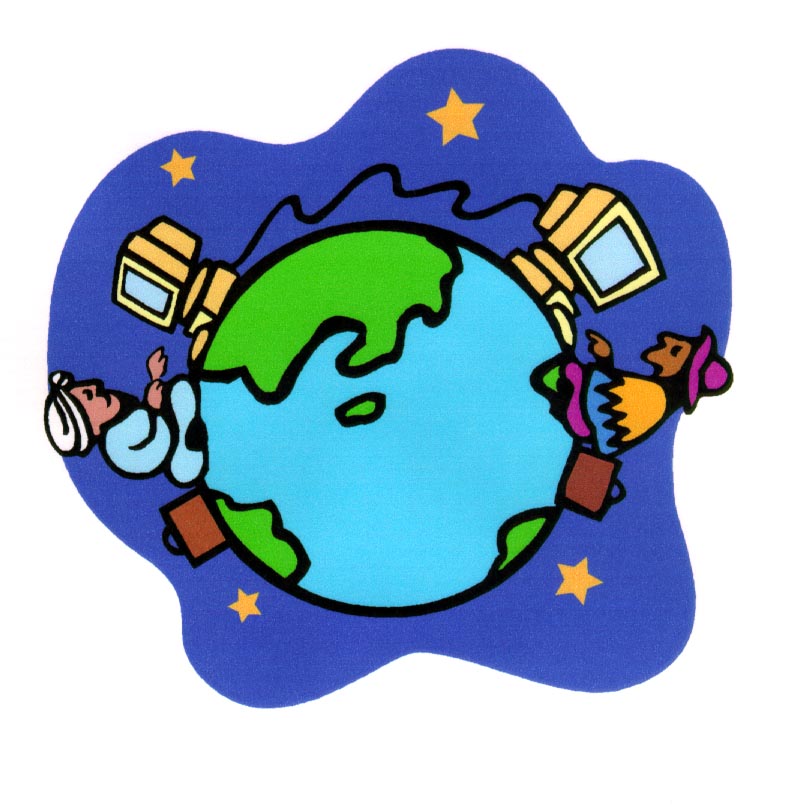
The term "globalization" has been used by economists since the 1980s although it was used in social sciences in the 1960s; however, its concepts did not become popular until the latter half of the 1980s and 1990s. Globalization in its literal sense is the process of transformation of local or regional phenomena into global ones. It can be described as a process by which the people of the world are unified into a single society and function together. This process is a combination of economic, technological, sociocultural and political forces. Globalization is often used to refer to economic globalization, that is, integration of national economies into the international economy through trade, foreign direct investment, capital flows, migration, and the spread of technology.
Tom G. Palmer of Cato Institute defines "globalization" as "the diminution or elimination of state-enforced restrictions on exchanges across borders and the increasingly integrated and complex global system of production and exchange that has emerged as a result."
Globalization is viewed as a centuries long process, tracking the expansion of human population and the growth of civilization, that has accelerated dramatically in the past 50 years. Early forms of globalization existed during the Roman Empire, the Parthian empire, and the Han Dynasty, when the Silk Road started in China, reached the boundaries of the Parthian empire, and continued onwards towards Rome. Globalization has had a tremendous impact on cultures, particularly indigenous cultures, around the world. In the 17th century, globalization became a business phenomenon when the British East India Company, which is often described as the first multinational corporation, was established.
Some effects of globalization in economic aspect is realization of a global common market, based on the freedom of exchange of goods and capital, in the industry the offer products foreign and access for this, for different consumers and companies. In the political, the creation of a world government with institutions such as WTO, World Bank and IMF in charge of regulate the relationships among governments and guarantees the rights arising from social and economic globalization.
Other examples globalization are the aspect cultural, ecological and technical. In the aspect cultural in the world have transformation of culture with cross cultural contacts, with adopt new technology, practices and news knowledge and thought. In the ecology aspect, begin a wake respect the importance of protect and preserve the global environmental such as climate change, cross-boundary water and air pollution, over-fishing of the ocean, and the spread of invasive species. In the technology aspect exist great example because global telecommunications infrastructure with use of internet, communication satellites, submarine fiber optic cable and wireless telephones.
In conclusion, thanks for globalization exits cross of culture, the access to any product of world, the communication with any person from any country without be a consequence the distance and knowledge about of preserve the environment. Is very important understand that the globalization depends totally the unification of language thanks for English.
Tom G. Palmer of Cato Institute defines "globalization" as "the diminution or elimination of state-enforced restrictions on exchanges across borders and the increasingly integrated and complex global system of production and exchange that has emerged as a result."
Globalization is viewed as a centuries long process, tracking the expansion of human population and the growth of civilization, that has accelerated dramatically in the past 50 years. Early forms of globalization existed during the Roman Empire, the Parthian empire, and the Han Dynasty, when the Silk Road started in China, reached the boundaries of the Parthian empire, and continued onwards towards Rome. Globalization has had a tremendous impact on cultures, particularly indigenous cultures, around the world. In the 17th century, globalization became a business phenomenon when the British East India Company, which is often described as the first multinational corporation, was established.
Some effects of globalization in economic aspect is realization of a global common market, based on the freedom of exchange of goods and capital, in the industry the offer products foreign and access for this, for different consumers and companies. In the political, the creation of a world government with institutions such as WTO, World Bank and IMF in charge of regulate the relationships among governments and guarantees the rights arising from social and economic globalization.
Other examples globalization are the aspect cultural, ecological and technical. In the aspect cultural in the world have transformation of culture with cross cultural contacts, with adopt new technology, practices and news knowledge and thought. In the ecology aspect, begin a wake respect the importance of protect and preserve the global environmental such as climate change, cross-boundary water and air pollution, over-fishing of the ocean, and the spread of invasive species. In the technology aspect exist great example because global telecommunications infrastructure with use of internet, communication satellites, submarine fiber optic cable and wireless telephones.
In conclusion, thanks for globalization exits cross of culture, the access to any product of world, the communication with any person from any country without be a consequence the distance and knowledge about of preserve the environment. Is very important understand that the globalization depends totally the unification of language thanks for English.

No comments:
Post a Comment